

Understand Car Radiator Coolant in Deeper
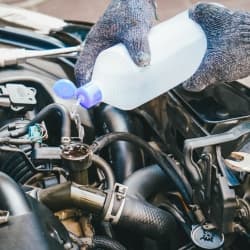
To reduce the hot air in the engine cylinder during the combustion process, vehicles use a radiator. In carrying out its duties, the radiator requires support from cooling fluid or radiator coolant so the ins and outs must be understood.
The radiator uses coolant to cool the cylinder walls of the car engine. Therefore, the liquid must be heat resistant.
If the radiator coolant is unable to reduce heat, the radiator's work can be disrupted. There is a big danger if this happens. The car can overheat so it breaks down and emits smoke.
Therefore, it is necessary to have an understanding of radiator coolant so that the car always performs at its best.
How Radiator Coolant Works
Before understanding how radiator coolant works, it's a good idea to first know about radiators in general. The radiator has several components in it, such as the radiator core, inlet tank, and outlet tank. Each part has its own use.
Radiator core or main radiator tube for example. This is a series consisting of fluid channel cavities and thin plates. Its function is to transfer heat from the cylinder to the plates and cavities. Meanwhile, the inlet and outlet tanks are fluid reservoirs which become circulation points from the engine and towards the engine.
The way the radiator works starts with coolant being pumped into the cylinder walls. This fluid absorbs and transfers heat from the cylinder walls to the outside to be cooled in the radiator core.
The process is carried out by transferring heat through the gap in the thermostat valve. This is a partition between the engine and radiator. The valve will open automatically when the heat reaches 90 degrees Celsius.
The hot, high-pressure air is then carried by the radiator coolant through the thermostat valve to the inlet tank. From there the radiator coolant will go to the radiator core which has cavities with thin plates.
The cooling process then occurs in the radiator core. The radiator fan will distribute cool air into the main radiator tube.
In this process, the function of the fluid channel cavities in the radiator core shows its function. This section is the entrance for cold air which is distributed by the fan and expels hot air.
After the temperature drops, the coolant will return to the tank outlet. The cooling process starts again from the beginning as before.
Types of Radiator Coolant
Because the function of radiator coolant is very important, choosing the right type is vital. Here are several types to choose from.
â— Water
Water can be a type of radiator cooling fluid. However, the performance is not optimal. Water already boils at 100 degrees Celsius so it will be overwhelmed when faced with high temperatures. For example, when the car gets stuck in traffic in the middle of a hot day.
If you use water as a coolant, the radiator's performance is limited because the water quickly evaporates and boils. Not only that, the presence of minerals in it can cause rust and scale. In the end, the radiator leaks easily.
â— Regular Coolant Radiator
Radiator coolant is usually made from a mixture of unmineralized water, propylene glycol anti-freeze and rust preventative. The combination of these materials allows heat to be absorbed and the radiator to remain free from corrosion.
The presence of propylene glycol is the key. This substance makes the radiator coolant have a higher boiling point than ordinary water. Propylene glycol only boils at 110 degrees Celsius.
Because the boiling point is higher, evaporation is also smaller. Thus, ordinary coolant radiators are very suitable for use in tropical regions like Indonesia.
â— Super Coolant Radiator
A type of radiator coolant with a higher boiling point. The content is similar to ordinary radiator coolant, but only boils at a temperature of 130 degrees Celsius.
Very suitable for tropical areas. However, the super coolant radiator must be melted first before use. Add water with a 50-50 composition to it when you want to use it.
â— Antifreeze & Coolant Protector
Similar to super coolant radiator, antifreeze & The coolant protector must be melted first by adding water. For Indonesia's tropical climate, the composition is 50 percent water and 50 percent antifreeze & coolant protector
The ability is similar to a super coolant radiator with a lower freezing point. Meanwhile, the boiling point reaches 128 degrees Celsius.
That is the use of radiator coolant and its types. Drivers must be diligent in checking so that the numbers remain adequate. It is recommended to replace it every 20,000 km to 50,000 km using the preferred radiator coolant.